Call intent detection is the step where an AI system listens to a caller, works out what they want (a booking, a price, a reschedule, a complaint) and decides what happens next. For a service business, it is the difference between a phone that merely gets answered and a phone that gets jobs booked. Wattle’s voice agents are built around this step: they pick up, ask relevant questions, book into your calendar in real time and pass sensitive or complex calls to your staff.
This guide explains how intent detection works on a phone call, which intents are worth automating first, how to test accuracy, and where a person should take over.
WattleTurn Caller Intent Into Clear Next StepsWattle’s AI voice agents ask relevant questions, book appointments, and hand sensitive or complex calls to your staff.VisitTL;DR
- Intent detection labels the purpose of a call, such as a new booking, a price enquiry or an existing-customer issue. It reads meaning in context rather than matching keywords.
- Calls are harder than chat: speech has to be transcribed first, and mistakes in transcription flow into the intent label.
- Start with a short list of clear intents (enquiry, booking, change, cancel, urgent) and define each one tightly, because vague categories cause misclassification.
- Measure intent accuracy and whether the task was completed, then review the calls that went wrong.
- Build a clear handover to a person for urgent, sensitive or unclear calls.
Table of Contents
- What call intent detection actually is
- How an AI agent detects intent during a call
- Which call intents to automate first
- Preparing your intents so detection works
- Handling unclear requests
- How to test and measure accuracy
- Our perspective
- Putting it to work with Wattle
- FAQ
- Sources
What call intent detection actually is
Intent is the goal behind what someone says. “Can you fit me in Thursday?”, “Are you free this week?” and “I need someone out here today” use different words but point to one intent: book a job. A detection system reads the conversation and assigns it a label from a list your business defines, for example new booking request, price enquiry, existing-customer support, supplier pitch or other.
That is different from keyword spotting. Keyword spotting only checks whether a set phrase appeared. Intent detection works from context, so it copes with synonyms, unusual phrasing and negation (“I don’t want to cancel, I want to move it”). A caller who says their car is locked and they are stuck in a car park never says “booking”, yet the intent is plain.
Why a phone call is a different problem from chat
Research presented at Interspeech 2023 found that intent definitions built for one channel cannot simply be reused for calls. Phrases such as “thank you for calling” belong to calls, and the word “calling” rarely appears in chat or email. The same study notes that picking key phrases by hand is slow because phone audio is noisy and transcripts contain errors, and that phrases rarely translate directly between languages.
The practical lesson: do not paste your website chatbot’s intent list onto your phone line and expect it to work. Callers ramble, interrupt, give the address before saying what they need and speak in accents and over background noise. A phone agent needs intents and prompts shaped for speech.
How an AI agent detects intent during a call
Most systems follow the same sequence:
- Speech to text. The caller’s audio is transcribed as they speak.
- Intent classification. A model reads the transcript so far and picks the most likely label, often alongside the extraction of details such as name, suburb or preferred time.
- Action. The system routes the call, asks a follow-up question, checks the calendar or hands over to a person.
Airbnb’s engineering team describes a version of this in its adaptive phone support: callers are transcribed, an intent model running in parallel classifies the issue into a contact reason in under 50 milliseconds on average, and the call goes to self-service or to a human agent with the details attached.
The same write-up shows why step one matters so much. General speech models misheard everyday product terms (“listing” came out as “lifting”), and adding a phrase list of the company’s own vocabulary and adapting to phone audio brought the word error rate down from 33% to about 10%. If your trade has its own terms, such as brand names, parts or suburb names, a transcription that knows them gives the intent model something sound to work from.
Detecting intent as the conversation unfolds
On a live call the system does not wait for the caller to finish. It forms an early guess, then confirms it by asking. “Sounds like you’d like to book a blocked-drain visit, is that right?” is both a clarifying question and a safety net. In Wattle, you configure each agent’s role, instructions, greeting, persona and guardrails, and can choose a conversational mode for flexible AI-led calls or a scripted mode for controlled, deterministic call flows. Scripted flows suit intents where the steps must never vary; conversational suits open enquiries.
Which call intents to automate first
The sensible starting point is the calls that are frequent, predictable and end in a clear action. For most Australian service businesses that means:
Intent What the agent does Typical hand-over trigger General enquiry (hours, service area, what you do) Answers from business information you provide Question outside the information supplied New booking Asks the qualifying questions, checks the calendar, books Complex quote or site inspection needed Change or cancel an appointment Verifies the caller, moves or cancels the slot Caller disputes a fee or policy Price enquiry Gives the ranges or next steps you have set Request for a custom quote Urgent or emergency Recognises urgency, collects key details Immediate transfer to staff Complaint or sensitive matter Records the details calmly Always a personWattle’s feature set covers this pattern: answering enquiries, qualifying leads, booking appointments, retrieving business information, collecting payments, and escalating sensitive or complex conversations to staff. For a trade example, see how an after-hours HVAC agent triages emergencies, books jobs and hands off.
When to transfer to a person
Set the handover rules before you go live, not after the first awkward call. Good triggers are:
- The caller is distressed, angry or raises a safety issue.
- The request involves money disputes, legal matters or health information.
- The system has asked twice and still cannot tell what the caller wants.
- The caller asks for a person.
Wattle includes human handover and lets you control handoff protocols, so these rules sit in the agent’s configuration rather than in someone’s memory. Australian mobile numbers, outbound calling and transfers are listed on the pricing page as a separate fee line without a published price.
Preparing your intents so detection works
The single biggest factor in accuracy is how you define the categories, not which model sits underneath.
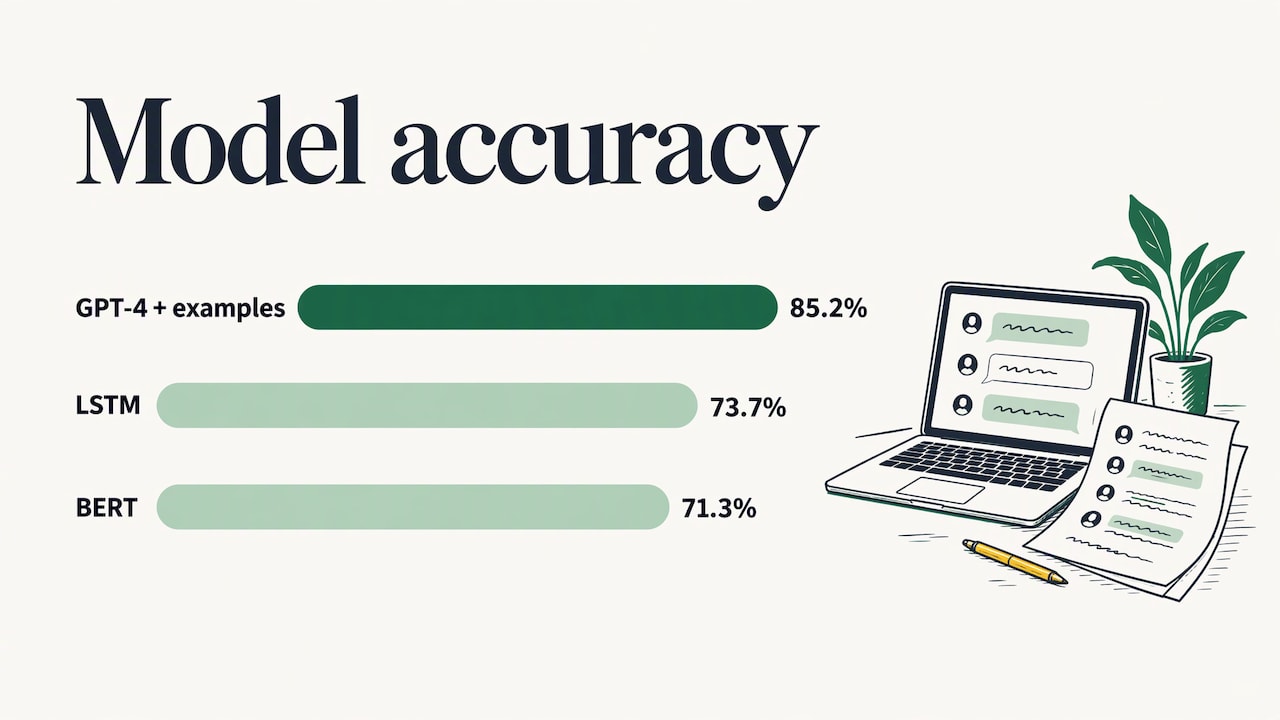
A peer-reviewed study of 430,355 sentences from a hospital call centre found that GPT-4 with a few examples reached 85.2% accuracy, against 73.7% for an LSTM model and 71.3% for BERT. The same study showed that categories overlap in practice: 33.5% of “Treatment” sentences were misclassified as rescheduling, and results improved when the categories were subdivided and described more precisely in the prompt. Your “change booking” and “new booking” intents will blur in the same way unless you spell out the difference.
A practical way to prepare:
- Pull a sample of real calls. Use recordings and transcripts from the last month or two. Read at least a few dozen.
- Group by outcome, not by wording. Ask what the business did as a result of each call.
- Write one-line definitions with an example and a counter-example. “Reschedule: caller has an existing booking and wants a different time. Not a reschedule: caller asks if you are available but has no booking.”
- Add an “unclear” intent. It gives the agent a legitimate place to land and triggers a clarifying question or handover.
- Tie each intent to a system action. Calendar, spreadsheet, accounting platform or automation tool. Wattle connects to existing calendars, spreadsheets, accounting platforms, phone numbers and automation tools, so a detected intent can end in a real booking rather than a note.
If you also run paid ads, mapping intents to revenue helps you see which call types turn into work. A guide on tying ad spend to closed sales in your CRM shows how to connect those outcomes to your marketing numbers.
Call transcripts are the raw material for all of this. Our guide to call transcript analysis covers turning recordings into decisions, and the piece on replacing your phone menu with AI shows what changes when callers can simply say what they need instead of pressing numbers. If you are weighing the older approach, the IVR versus voicebot comparison for Australian teams sets it out.
Handling unclear requests
People are not tidy callers. Three patterns come up constantly:
- Two intents in one call. “I need to move my booking and also get a quote for another job.” The agent should handle them in sequence and confirm both.
- Vague openers. “Hi, I’ve got a problem with my order.” A single open question (“What’s happened?”) usually reveals the intent.
- Mishearing. Noisy lines and strong accents produce transcription errors. Confirming back the key detail, such as the day, suburb or job type, catches most of them before they become a wrong booking.
If your callers speak more than one language, define intents per language rather than translating a list, as the Interspeech authors found direct translation of key phrases often fails. Our 10-step guide to rolling out multilingual support goes into that.
How to test and measure accuracy
Track three things together, because intent accuracy alone can look healthy while customers are still unhappy.
- Intent accuracy. Take a sample of calls, have a person label the true intent, and compare. Look at the confusion pairs (which intents get mistaken for which), not just the overall percentage. The hospital study’s treatment-versus-rescheduling confusion is exactly this kind of finding.
- Task completion. Did the booking land in the calendar? Was the right detail captured? A correctly labelled call that ends without an action is still a miss.
- Customer experience. Look at handover rate, repeat calls on the same issue and caller feedback. Airbnb reported that better transcription fed through to better help recommendations, customer satisfaction scores and handling time.
Review weekly at first. Every misclassified call tells you either that a definition is loose, a phrase is missing from your vocabulary list, or a handover rule is set too late. Fix the definition, then re-check the same calls.
Our perspective
Most businesses do not lose work because their phone lines are bad. They lose it because the call was picked up late, or by someone who was already on another job, or went to voicemail after hours. Detecting intent is only useful if it ends in an action: a booked slot, a captured lead, a person taking over at the right moment.
That is why we build Wattle as an AI front desk rather than a call classifier. The agent answers, asks the questions you would ask, books into your calendar, and hands the important conversations to your team. You decide how much freedom it has: conversational where flexibility helps, scripted where the steps must be exact.
Phone, web chat, WhatsApp and SMS land in a single inbox, so a customer who rings and then texts is one conversation, not two. We offer local Australian support, and we think a clear intent list, a firm handover rule and a weekly look at real transcripts will do more for your results than any amount of tuning.
Christopher
Putting it to work with Wattle
Wattle gives service businesses an AI front desk that answers calls and chats, books work, takes payments and hands important conversations to people. Plans are published on the pricing page: Starter is A$99 per month, Pro is A$499 per month and Max is A$999 per month.
You can see how an agent handles your own kind of call by trying an AI receptionist. To size the opportunity first, the after-hours revenue calculator gives a feel for what unanswered calls cost. The features page lists the agent controls in full.
FAQ
Is call intent detection the same as speech recognition?
No. Speech recognition turns audio into text. Intent detection reads that text and decides what the caller wants. The two work in sequence, so transcription errors can carry into the intent label, which is why domain vocabulary matters.
How is it different from a phone menu (IVR)?
A phone menu asks callers to press numbers or pick from fixed options. Intent detection lets them say what they need in their own words and works out the purpose from context. Our intelligent call routing guide shows how routing improves once the system knows the reason for the call.
How many intents should I start with?
Five to eight is a workable start: enquiry, new booking, change or cancel, price, urgent and an unclear or other category. Add more only when transcripts show a repeating call type that the list handles badly.
What happens when the AI cannot tell what the caller wants?
It should ask a clarifying question once or twice, then hand the call to a person with the details collected so far. In Wattle you set the handover rules, so unclear, urgent or sensitive conversations go to your staff.
Sources
- Cross-lingual/Cross-channel Intent Detection in Contact Centers (Interspeech 2023)
- Listening, Learning, and Helping at Scale: How Machine Learning Transforms Airbnb’s Voice Support Experience
- Leveraging Large Language Models for Improved Understanding of Communications With Patients With Cancer in a Call Center Setting