Yes, businesses can accept and confirm same day appointments using AI voice and chat agents, provided the agent has live calendar access and clear availability rules. That combination matters more than the AI model itself. Some AI agents book appointments in real time by syncing directly with calendars, and Databricks notes that omnichannel platforms with proper governance are what prevent booking chaos when demand spikes.
TL;DR:
- Successful same day booking requires real-time calendar access, clear rules, and the ability to write directly to the calendar without human intervention.
- Policy decisions like lead times, service-resource mapping, and eligibility rules must be finalized before deployment to prevent scheduling conflicts.
- Matching the booking channel to customer preferences, with confirmation of details and immediate invites, improves customer experience and reduces errors.
- Rigorous governance, including identity verification, audit logs, and fallback options, is essential to maintain trust and compliance in rapid bookings.
- Pilot programs should track key metrics over three to five weeks and include controlled testing of fallback flows to minimize operational risks.
Table of Contents
- Can AI agents actually confirm same day bookings?
- Essential configuration: calendars, rules and booking policy decisions
- Which booking channel should you actually use?
- Operations and governance: human handoff, verification and auditability
- How do you pilot same day booking before rolling it out fully?
- Implementation checklist: concrete steps to enable same day booking with AI agents
- Benefits and potential challenges of offering same day appointments
- Where same day appointments matter most
- Managing expectations when the appointment is today
- Legal and compliance considerations for same day scheduling
- When same day AI booking is worth it
- How Wattle handles same day booking for your business
- Sources
Can AI agents actually confirm same day bookings?
Same day booking works when three things line up: the agent can read your calendar, it knows your rules, and it can write to that calendar without waiting for a human to press a button. Miss any one of those and you get a chatbot that collects details and then emails someone to “confirm” the slot hours later, which defeats the entire purpose.
The end-to-end flow has four moving parts. First, availability discovery: the agent checks your live calendar and works out which slots are genuinely open right now, not which ones looked open five minutes ago. Second, slot selection, which is more than just picking the earliest gap. A scheduling agent needs to weigh service length, which staff member is qualified, and whether a resource like a treatment room is free for that window. Third comes the booking write itself, the transactional step that actually creates the appointment and sends confirmation before the caller hangs up. Fourth, post booking automation takes over: reminders, rescheduling offers if something falls through, and waitlist triggers when a same day slot opens unexpectedly.
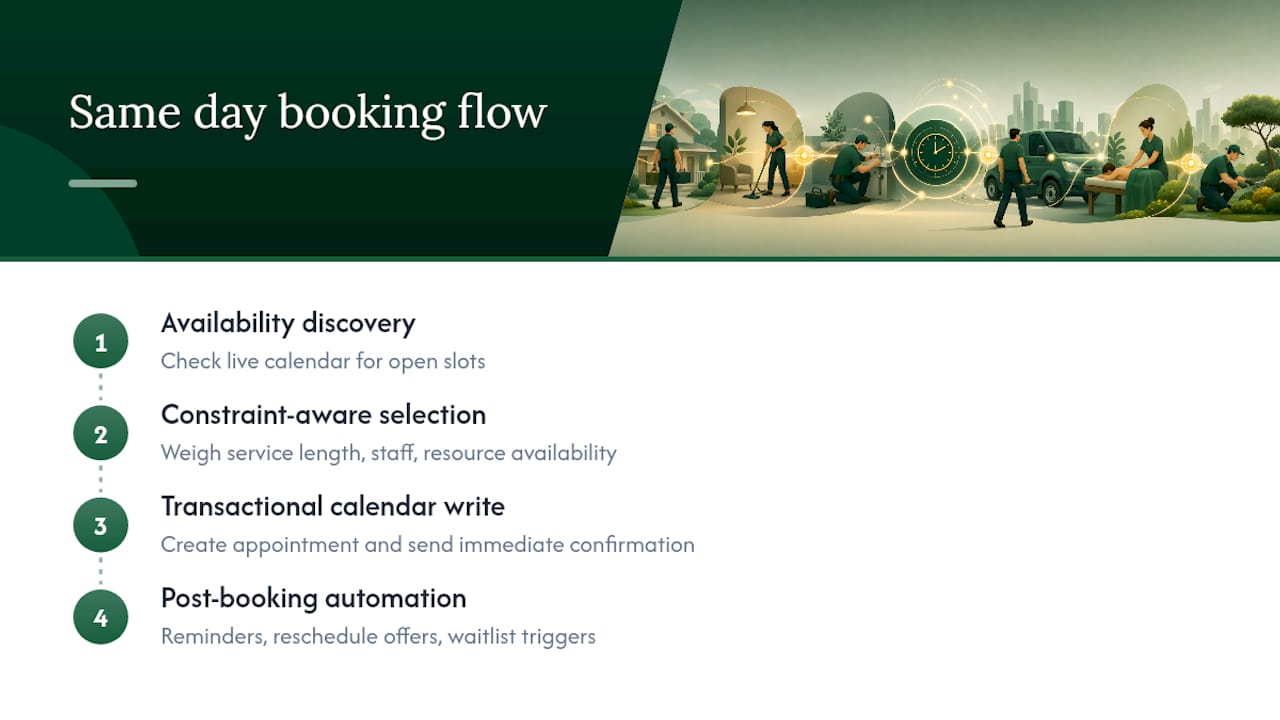
Skip step three and you haven’t built a booking system. You’ve built a very polite form.
Essential configuration: calendars, rules and booking policy decisions
Before any agent touches a calendar, someone on your team has to make a handful of policy calls. These aren’t technical settings buried in a dashboard. They’re business decisions that determine whether same day booking actually reduces admin work or just creates new headaches.
Start with lead time. Do you allow bookings with zero notice, or does every same day slot need a two hour buffer so staff aren’t blindsided? Vendasta’s research on booking automation points to calendar sync and reminder automation as the features that most reliably cut down on missed appointments, but none of that helps if your lead time policy is undocumented and every staff member enforces it differently.
Other configuration decisions worth locking in early:
- Block recurring non booking windows, such as lunch breaks and admin blocks, so the agent never offers a slot that looks free but isn’t.
- Map each service to the specific staff or resources qualified to deliver it, so a haircut doesn’t get booked against a colourist’s calendar.
- Set eligibility rules for who can book same day (new versus returning customers, for example) and flag which actions need human sign off.
- Confirm real time sync with your calendar backend, whether that’s Google Calendar, Cal.com, or a practice management system, so double bookings don’t slip through.
Get these settled before launch, not after the first scheduling conflict.
Which booking channel should you actually use?
Not every customer wants to talk to a bot the same way. Someone driving to a jobsite calls. Someone scrolling your website at 11pm chats. Someone who already texts their dentist wants WhatsApp. Matching the channel to the moment is what makes same day service scheduling feel effortless instead of forced.
Voice suits phone-first customers and anyone booking something complicated enough that they want to hear it confirmed out loud. NodeSure’s analysis of after-hours booking found that voice and native messaging convert particularly well when they’re already the customer’s default channel, and that AI can turn an after-hours enquiry into a confirmed booking in under two minutes.
A few channel design notes worth building into every flow:
- Chat widgets convert best when triggered at the moment of intent, such as a proactive prompt after someone lingers on a pricing page.
- WhatsApp and SMS work well for mobile-first customers who want a persistent thread they can return to, rather than a one-off call.
- Limit slot choices to two or three options at a time. Nobody wants to scroll through fourteen time slots on a phone screen.
- Always confirm full details back to the customer and fire off an immediate calendar invite, regardless of which channel closed the booking.
Operations and governance: human handoff, verification and auditability
Same day booking is where automation earns trust or loses it fast, because there’s no buffer time to catch mistakes before the customer shows up. Governance isn’t a compliance afterthought here. It’s the thing that keeps a booking system safe enough to leave running unattended overnight.
Set confidence thresholds that automatically route a conversation to a human when the agent isn’t certain it understood the request correctly. Anything involving a protected action, cancelling an existing booking, changing payment details, or confirming a sensitive appointment type, should require identity verification, whether that’s a one-time SMS code or a simple confirmation prompt repeating the details back.
Every transactional write needs an audit trail. If a booking gets created, moved, or cancelled, there should be a log entry showing what happened and when, because “the AI did something” is not an acceptable answer when a customer disputes a charge or a missed slot.
Fallback design matters as much as the happy path. Databricks makes the point that a good fallback offers a concrete next step, such as a callback or a specialist handoff, rather than a dead-end apology. An agent that says “I couldn’t book that, but I’ve flagged it for our team to call you back in ten minutes” preserves the customer relationship. One that just says “sorry, I can’t help with that” burns it.
How do you pilot same day booking before rolling it out fully?
Don’t launch same day booking across every service line on day one. Pick one service, a limited pool of staff, and a constrained set of hours, then run it as a genuine test rather than a soft launch dressed up as a full rollout.
Track five numbers throughout: booking completion rate (how many attempts turn into confirmed slots), time-to-book (how long the whole exchange takes), human intervention rate (how often the agent had to hand off), no-show rate, and customer satisfaction. ValueStreamAI makes the case that real user testing surfaces edge cases QA simply never finds, because actual customers ask things your test scripts never anticipated.
Run the pilot for three to five weeks. Shorter than that and you won’t see enough volume to trust the numbers; longer and you’re delaying fixes that real bookings have already told you to make. Use what you learn to tighten flows and guardrails before expanding to other services or locations.
Implementation checklist: concrete steps to enable same day booking with AI agents
Turning the theory into a working system comes down to four ordered moves.
- Audit every system the agent needs to read from or write to. That means calendar APIs, CRM records, and any booking backend, checked for both read and write permissions before you build a single flow.
- Define your booking policies and write them down. Lead times, eligibility rules, confirmation cadence, and who gets notified when. Undocumented policy is the single biggest cause of inconsistent same day service later.
- Configure and test flows across every channel you plan to use, including verification steps and the human handoff points that catch anything the agent shouldn’t handle alone.
- Run a controlled pilot, review the KPIs, then expand with monitoring dashboards in place so you catch problems before customers do.
Pro Tip: Test your fallback flow deliberately, not just your happy path. Call your own agent, ask for a booking type it should reject, and check it offers a real next step instead of a dead end.
Benefits and potential challenges of offering same day appointments
The upside is straightforward: businesses that offer immediate appointments capture demand that would otherwise walk to a competitor. A customer with a leaking tap or a chipped tooth rarely wants to book three days out; they want the next available slot, and whoever answers first usually wins the job. Vendasta’s data on 24/7 booking automation shows that calendar-connected systems capture leads outside business hours, which is exactly when urgent requests tend to arrive.
The challenges are just as real, though, and worth naming honestly. Same day slots compress your margin for error. There’s no three-day buffer to catch a double booking or a miscommunicated service length before the customer arrives. Staff schedules need genuine flexibility, because a same day policy that promises availability your rota can’t actually deliver just creates frustrated customers and overworked staff.
There’s also a resourcing tension: same day appointments often carry a premium in trades and healthcare precisely because they disrupt planned work, but customers don’t always expect to pay more for speed. Setting that expectation clearly, ideally at the point of booking, avoids an awkward conversation later. And on the operations side, a booking system with no slack means a single no-show or late cancellation has a bigger relative impact on your day’s revenue than it would on a lightly booked schedule.
None of this argues against offering same day appointments. It argues for building the guardrails discussed earlier before you promise the speed.
Where same day appointments matter most
Some industries live or die on how fast they can turn an enquiry into a booked slot. Trades are the obvious case: a burst pipe or a dead air conditioner in summer is not a problem anyone wants to schedule for next Tuesday. Whoever picks up the phone (or answers the WhatsApp message) first usually gets the job, which is exactly why missed calls are so costly in that sector.
Personal care and wellness services, hairdressers, beauty clinics, physiotherapists, run on a similar rhythm. Cancellations open same day gaps constantly, and filling them quickly protects revenue that would otherwise evaporate. A waitlist trigger that texts the next person in line the moment a slot frees up turns a cancellation from a loss into a same-day win.
Professional services with urgent components, such as locksmiths, IT support, and vehicle repair, share the same pattern: customers are already in a mildly stressed state and want resolution now, not a booking confirmation email that arrives in three days. Retail click-and-collect and same day fitting services (eyewear, tailoring) also depend on immediate scheduling to compete with larger chains that promise speed as a core feature.
By contrast, services with naturally long lead times, major renovations, legal consultations requiring document preparation, gain less from same day booking and more from accurate scheduling further out. The businesses that benefit most from automating immediate appointments share one trait: demand that spikes unpredictably and customers who treat speed as part of the service itself, not a bonus.
Managing expectations when the appointment is today
Same day bookings create a specific communication challenge: the customer has almost no time to adjust their expectations before the appointment happens. Get the messaging wrong and even a successfully booked slot can feel chaotic.
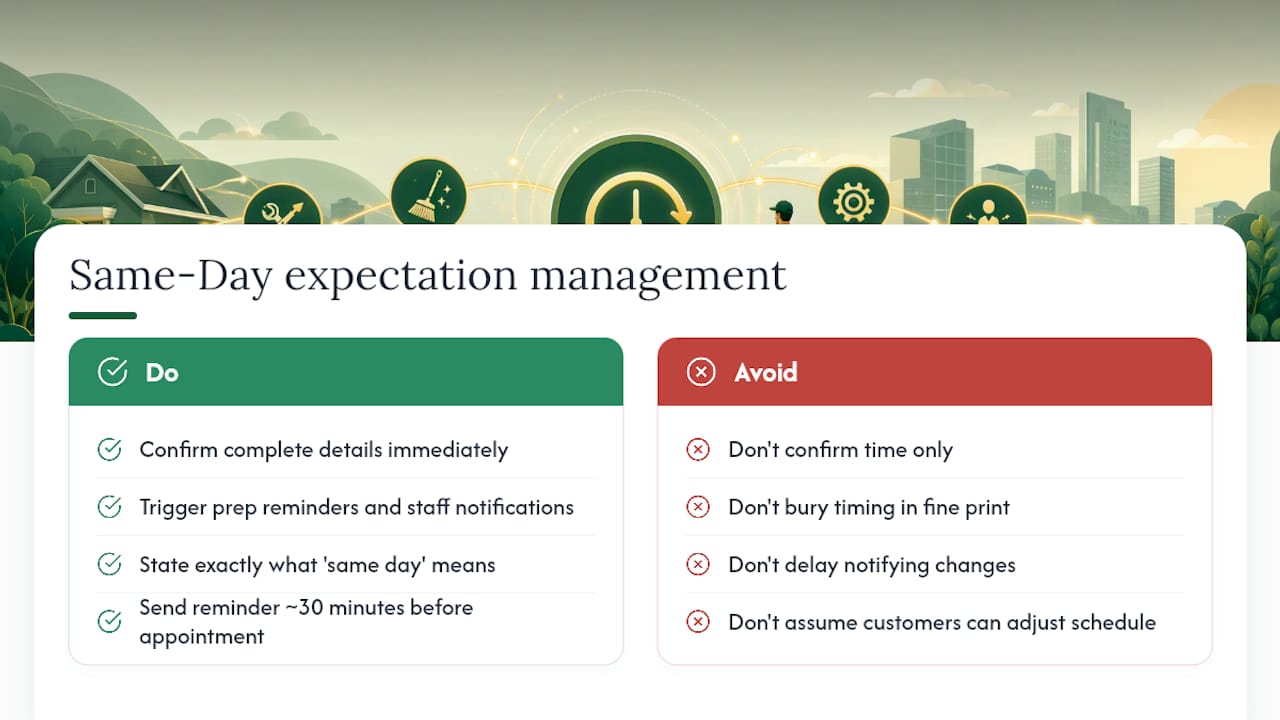
Confirm details immediately and confirm them completely. A booking confirmation that only states the time, without the address, what to bring, or how long the visit will take, forces the customer to call back and ask, which defeats the point of automating the booking in the first place. Vendasta’s research frames bookings as triggers for a wider journey, prep reminders, internal staff notifications, and follow-up messages, rather than a single isolated event, and that framing matters most on the day something is actually happening.
Be explicit about what “same day” actually guarantees. If it means “within business hours today” rather than “within the next hour,” say so plainly at the point of booking, not as a caveat buried in fine print. Ambiguity here creates the sharpest customer frustration, because expectations formed in the moment of booking are hard to walk back once they’re set.
Send a reminder closer to the appointment than you would for a booking made a week out, since same day customers have had no time to mentally prepare. A message thirty minutes before, rather than the standard day-before reminder, suits the compressed timeline. And if something changes on your end, a delay, a staff substitution, tell the customer the moment you know, not the moment they’re due to arrive. Same day customers have less patience for surprises precisely because they organised their whole day around a slot they booked hours ago.
Legal and compliance considerations for same day scheduling
Same day booking doesn’t exist in a compliance vacuum, and the faster the transaction, the less room there is to catch an oversight before it becomes a problem.
Identity verification matters more, not less, when bookings happen instantly. A same day appointment that involves a protected action, changing payment details, cancelling on someone else’s behalf, rescheduling a sensitive service, needs the same verification standard as a booking made a week in advance. Speed is never a valid reason to skip a confirmation step.
Data handling deserves particular attention if your booking flow captures personal information over voice, chat, or SMS. Call recordings and transcripts, if you use them, should be collected with clear consent, and stored with proper access controls, since a same day booking system that logs sensitive health or financial details needs the same data governance as any other customer record system.
Cancellation and refund policies also need to be applied consistently regardless of how little notice a customer gives. If your standard policy requires 24 hours’ notice for a full refund, a same day booking model effectively removes that grace period, so it’s worth deciding in advance how that tension gets resolved and stating the policy clearly at the point of booking rather than after a dispute arises.
Finally, keep audit logs for every automated transactional action, not just the ones that go wrong. If a regulator, a payment processor, or a customer ever challenges a booking, cancellation, or charge, a clear record of what the agent did and when is the difference between a five-minute resolution and a drawn-out dispute.
When same day AI booking is worth it
Same day AI booking earns its keep fastest in businesses with short services, flexible staff rosters, and a high volume of inbound enquiries; think hairdressers, trades callouts, and clinics with rolling availability. The math is simple: the more often a human would otherwise be the bottleneck between “customer wants a slot” and “slot is booked,” the more value automation adds.
The most common implementation mistake isn’t a bad AI model. It’s incomplete system access, an agent that can read a calendar but can’t actually write to it, or a fallback flow so weak it strands a frustrated customer with no next step. A close second is skipping the monitoring pipeline entirely, launching same day booking and only checking on it when something goes wrong.
My rule of thumb: keep a human in the loop for every exception case, and instrument every booking so you can roll back fast if something breaks. Same day booking rewards businesses that treat it as an operational system to be monitored, not a feature to be switched on and forgotten.
— Christopher
How Wattle handles same day booking for your business
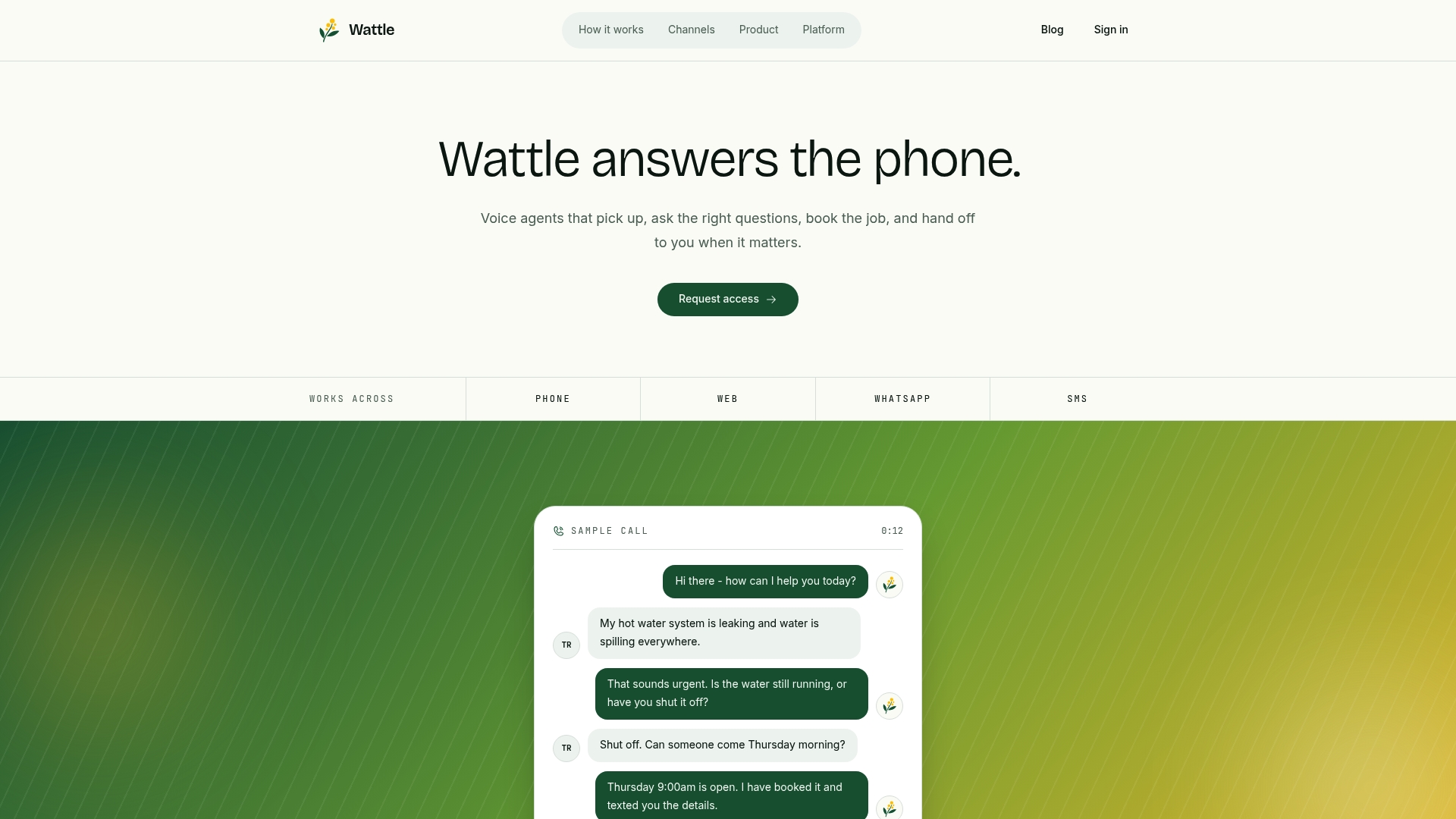
Wattle is built specifically for the moment this article has been describing: a customer wants a slot today, and someone (or something) needs to check the calendar, confirm eligibility, and book it before that customer calls a competitor instead. Some AI voice and chat agents run across phone, web, WhatsApp, and SMS, feeding into one inbox, with a call-flow builder that lets users set rules like lead times, eligibility checks, and confirmation steps.
Governance features may include protected actions requiring explicit confirmation, sensitive changes triggering identity verification, and transactional bookings generating audit events for review. When Wattle’s agent hits a case it isn’t confident handling, it hands off to a staff member rather than guessing. On the integration side, Wattle connects to Google Calendar and Cal.com for real-time availability and booking writes, and to Stripe for payment collection, so a same day booking can be confirmed and paid for in the same conversation. If your team is still handling same day requests over the phone one caller at a time, it’s worth trialling Wattle on a single service line and watching what happens to your booking completion rate. Businesses looking to turn those bookings into a fuller customer journey, follow-up campaigns, review requests, repeat visit reminders, can pair that setup with a partner like HarbourSide Digital for the marketing side of the equation.
Sources
This guide draws on published research into AI customer service architecture and appointment automation. Databricks covers agentic AI governance and omnichannel design. Vendasta details the business case for automated booking and calendar integration. ValueStreamAI explains scheduling agent workflow patterns and constraint handling. NodeSure provides practical examples of 24/7 booking conversion across channels.
- AI customer service: strategy, agents, and solutions guide | Databricks Blog
- AI Appointment Booking Automation: How Businesses Fill Their Calendar 24/7 - Vendasta
- AI Scheduling Agents: Complete Automation Guide (2026) | ValueStreamAI
- AI Appointment Booking Automation: How Businesses Fill Their Calendar 24/7 - NodeSure Technologies