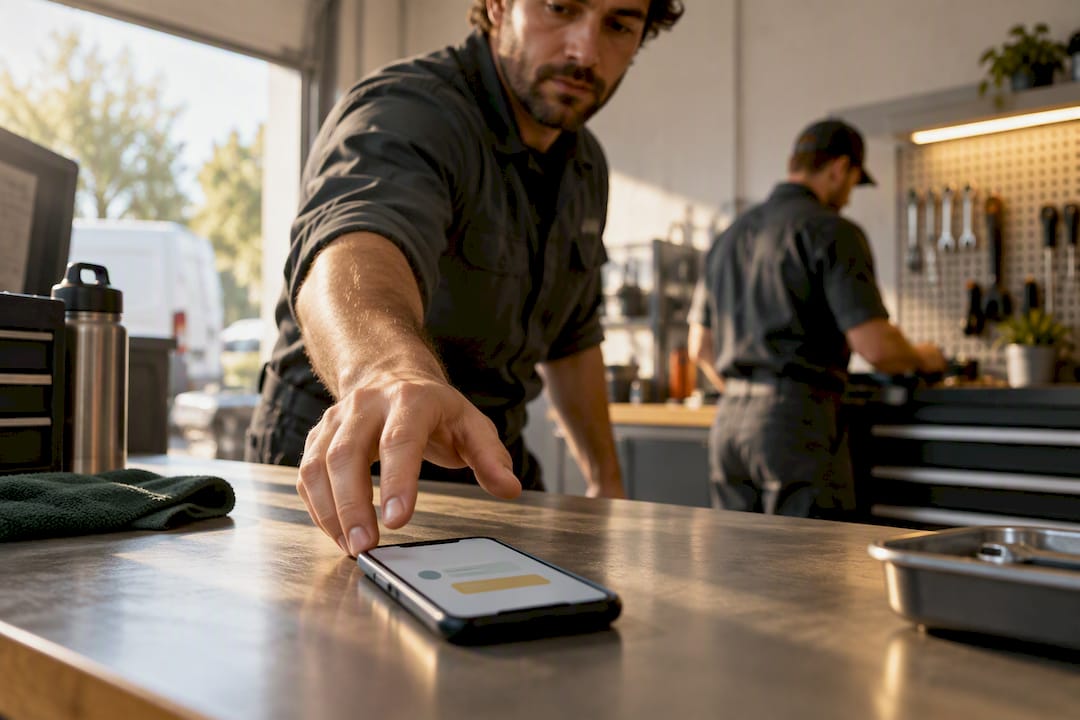
Missed call texting automatically sends an SMS to anyone whose call goes unanswered, so the conversation continues by text instead of dying in voicemail. It works because most callers who hit voicemail simply hang up and try a competitor. Enable it now and you recover leads within seconds instead of hoping someone calls back. This can be set up as part of a broader call answering system.
TL;DR:
- Properly set triggers and routing rules are crucial; misrouting replies can result in missed opportunities despite automated responses.
- Using SMS instead of voicemail reduces friction, keeping callers engaged and increasing the likelihood of converting missed calls into bookings.
- Keep auto-replies short, personal, and targeted, with clear identification, a brief apology, and a single question, all under 160 characters.
- Assign a specific owner for replies and establish quick response times with escalation rules to maximize conversion rates.
- Regularly monitor key metrics like reply rate and recovery rate to optimize performance and identify areas needing adjustment.
WattleTurn Missed Calls Into ConversationsWattle sends automatic missed-call texts, supports SMS follow-up, and keeps customer conversations together in one unified inbox.See Wattle’s AI front desk
Table of Contents
- What is missed call texting and how does it work?
- Why does SMS work better than voicemail for missed calls?
- What should you write in a missed call auto reply?
- How do you set up missed call texting step by step?
- Who should own the reply, and how fast should they respond?
- How do you measure whether missed call texting is working?
- What compliance rules apply to missed call text back?
- How Wattle builds missed call texting into your front desk
- The quick win most businesses miss
- Trial Wattle for missed call texting that actually converts
- Sources
- FAQ
What is missed call texting and how does it work?
Missed call texting fires the moment a call goes unanswered, and the trigger conditions decide how well it performs. Most systems let you set the trigger to fire on a ring out, a call landing in voicemail, an after hours closure, or a call bouncing through a ring group with nobody picking up. Once triggered, a two-way SMS goes out from the same number the caller dialled, usually within seconds, so it looks and feels like a natural reply rather than a bot message.
The send is the easy part. What happens to the reply is where most businesses fall down. According to Aloware, the automation itself just sends the text. Whether that text actually recovers the caller depends entirely on where the reply lands and who owns it.
Replies typically route to one of three places:
- A named staff member’s phone, so the same person who’d have taken the call now takes the text
- A monitored queue shared across a small team, with clear rules on who picks up what
- A unified inbox that pulls calls, SMS, web chat, and other channels into one thread per customer
Get the trigger right and the send right but leave the reply routing to chance, and you’ve just built a very fast way to ignore people. The routing decision is the one that actually determines whether a missed call turns into a booking.
Why does SMS work better than voicemail for missed calls?
Voicemail asks a stressed, busy caller to record a message and wait. SMS asks them to glance at a notification and tap a reply. That difference in friction is why text back consistently outperforms the old voicemail model for recovering missed calls.
Missed call recovery works because it removes the wait. A caller who hears “please leave a message after the tone” has already started looking for your competitor’s number. A caller who gets a text within seconds that says “sorry we missed you, what can we help with?” is still engaged, because someone has visibly responded.
Trade businesses see this play out constantly. InstantLead’s guide for tradies notes that a huge share of calls into trade businesses go unanswered simply because the tradesperson is up a ladder or under a car, not because the business doesn’t want the work. The same pattern shows up in clinics, salons, and other field services where the person who’d answer the phone is physically busy with a client for most of the day.

Pro Tip: If you only fix one thing this month, fix the after hours message. Calls that come in outside business hours are the easiest wins because there’s zero competition for that lead’s attention right now.
What should you write in a missed call auto reply?
Keep it short, personal, and single purpose. According to WorkflowStack AI, the structure that reliably beats generic voicemail style texts is simple: name, brief apology, one question. Nothing else competes for the reader’s attention.
Three templates that follow that structure:
- Friendly: “Hi, this is Sam from [Business]. Sorry we missed your call, what can we help with?”
- Professional: “Hi, [Business] here. We missed your call, apologies. Could you let us know what you need so we can get back to you fast?”
- Urgent/job focused: “Hey, [Business] here, sorry we missed you. Is this urgent, or can we call you back within the hour?”
Each one sits comfortably under 160 characters, so it sends as a single SMS.
The three rules behind all of them: identify yourself, apologise once, ask exactly one question. Skip links and offers in this first message. A text back that opens with a discount code reads as spam, not as a real reply.
Compare “We’re sorry we missed your call. Please visit our website to book an appointment or call back during business hours” against “Hi, this is Jess from Riverside Plumbing, sorry we missed you, what’s the job?” The first is a wall of text nobody wants to read on a phone screen. The second gets answered because it sounds like a person, not a policy.
How do you set up missed call texting step by step?
Setting this up takes one focused session, not a week of configuration. Work through it in order:
- Secure a two way SMS number. Port your existing business line or pick a new mobile number, and confirm it supports two way text, not just outbound calling.
- Set triggers per line. Decide which lines fire on ring out, which fire on voicemail, and whether after hours calls get a different message.
- Write your open and closed hours messages. Business hours texts can promise a callback soon; after hours texts should set a clear expectation for the next morning.
- Route replies to a monitored inbox. Assign a named owner or an assignment rule so no reply sits unread, and set an escalation trigger for unattended threads.
- Add a booking link where useful. A calendar link in the second message (never the first) lets warm leads self-serve straight into a slot.
- Test the full loop. Call your own number, let it go unanswered, confirm the text arrives, reply as the “customer,” and check it lands where you expect. Rocketlauncher notes this can run natively on many VoIP platforms, or be stitched together with tools like Twilio or Zapier where native support is missing.
Test on a real phone, not a simulator, before you trust it with live calls.
Who should own the reply, and how fast should they respond?
The text sending itself is the trivial half of this system. Ownership and speed on the reply side are what actually convert a missed call into revenue.
- Name an owner, not a queue. A specific person attached to a number responds faster than a shared inbox nobody feels responsible for.
- Set an escalation SLA. A common rule: if nobody has picked up a reply within 15 minutes during business hours, escalate to a second person or a manager.
- Attach every thread to a contact record. This starts a follow up clock and stops the same lead getting a duplicate “sorry we missed you” text three times in one day.
- Automate the boring parts. Calendar and CRM integrations can push a booking straight from the SMS thread into a confirmed slot without anyone touching a spreadsheet.
Industry guidance on telco consumer protections points at the same operational gap: the TIO’s response to ACMA’s decision on stronger consumer protections highlights routing and ownership as the controls that separate systems that genuinely serve customers from ones that just generate noise.
Pro Tip: Anonymous shared inboxes are where good leads go to die. If three people can see a reply, assume none of them will act on it first.
How do you measure whether missed call texting is working?
Four numbers tell you almost everything you need to know, and none of them require complex tooling to track.
Metric What it tells you How to calculate it Reply rate How many texted callers respond at all Replies received ÷ texts sent Median human response time How fast your team actually picks up replies Median time from reply received to staff response Conversations reaching booking How many replies turn into a scheduled job Booked conversations ÷ total replies Recovery rate Overall system performance Booked conversations ÷ total missed callsRecovery rate is the number that matters most to the owner, because it ties directly back to jobs won versus calls lost. Review these weekly for the first month while you tune templates and routing, then shift to a monthly cadence once the numbers settle. A simple spreadsheet with these four columns beats a dashboard nobody opens.
What compliance rules apply to missed call text back?
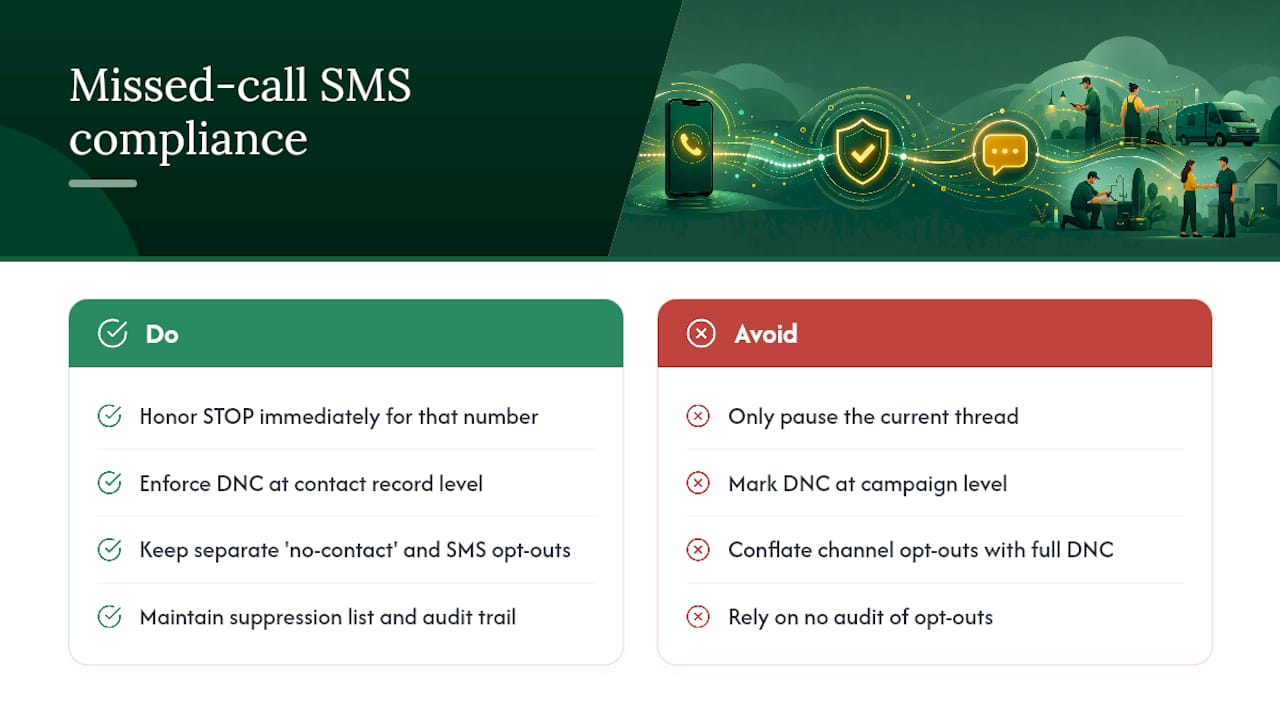
Keep this part boring and consistent, because it protects you from complaints and repeat message annoyance. STOP replies need to suppress every future text to that number immediately, not just pause the current thread. Omnyra is blunt about this: contact-level do-not-contact flags have to be enforced at the record level, not the campaign level, or the same person keeps getting texted from a different workflow.
Separate “do not contact by any channel” from “opted out of SMS specifically.” Someone can decline texts but still want a call back, and conflating the two annoys customers who thought they’d been heard. Keep a simple suppression list and a basic audit trail of opt outs and opt ins. It takes minutes to set up and saves you from repeat message complaints later.
How Wattle builds missed call texting into your front desk
Wattle handles this as part of a wider AI voice agent setup rather than a bolt on script. Two way SMS follows automatically after a missed or completed call, call flow builder logic decides routing, and named owner assignment sends replies into a unified inbox alongside web chat and WhatsApp threads. Reporting on reply rate and response time sits in the same dashboard, and calendar and CRM integrations turn a booked reply into a confirmed appointment without manual entry. Encrypted credentials and row level data security back the sensitive parts of that workflow.
The quick win most businesses miss
Test one template today. Call your own number after hours, read the reply as a stranger would, and fix anything that sounds automated. The most common pitfall isn’t the tech. It’s a monitored inbox nobody actually monitors.
— Christopher
Trial Wattle for missed call texting that actually converts
Wattle is the alternative to stitching together a VoIP text plugin, a separate CRM, and a spreadsheet to track who replied to what. Every checklist item in this guide, two way SMS, named owner routing, reply reporting, and calendar integration, comes built into one workspace instead of three disconnected tools.
You configure agents, connect your existing calendar and phone number, and manage every call and text from a single inbox, with support available if you need help getting set up. Most businesses have their first missed call trigger live within a single onboarding session. If you’re coordinating handoffs across a broader service team, a partner like Jubiliq can help align the event or operations side of that workflow too. Check the Starter, Pro, and Max plans on the pricing page or look through the full feature set to see what fits your call volume, then start a trial and test your first template this week.
Sources
- Missed Call Text Back: How to Recover Lost Calls | Aloware
- TIO welcomes ACMA decision to create stronger telco consumer protections | TIO
- The Complete Guide to Missed-Call Text Back | WorkflowStack AI
- Omnyra
FAQ
How do I text someone about a missed call?
Send a short SMS from the number they called, naming your business, apologising briefly, and asking one question about what they need. Most missed call texting systems, including Wattle, do this automatically within seconds of the call going unanswered.
Can I automatically text back a missed call?
Yes. Missed call auto reply systems trigger on ring out, voicemail, or after hours conditions and send a two way SMS without staff needing to do anything manually. The reply still needs a named owner or monitored queue to land somewhere useful.
How do I get a text message when I miss a call?
That depends on whether you mean as the caller or the business receiving the missed call. As a business, you set up missed call notifications through your phone system or a platform like Wattle so a text goes out to the caller and an alert reaches your team simultaneously.
How do I turn off missed call text messages?
Turning off carrier level missed call alerts on your own phone is done through your carrier’s app or account settings, and options vary by provider. If you’re referring to a business’s missed call auto reply system, that’s controlled in the platform’s trigger settings, not through your mobile carrier.